Research Generation

From topic to full project, chapter by chapter.

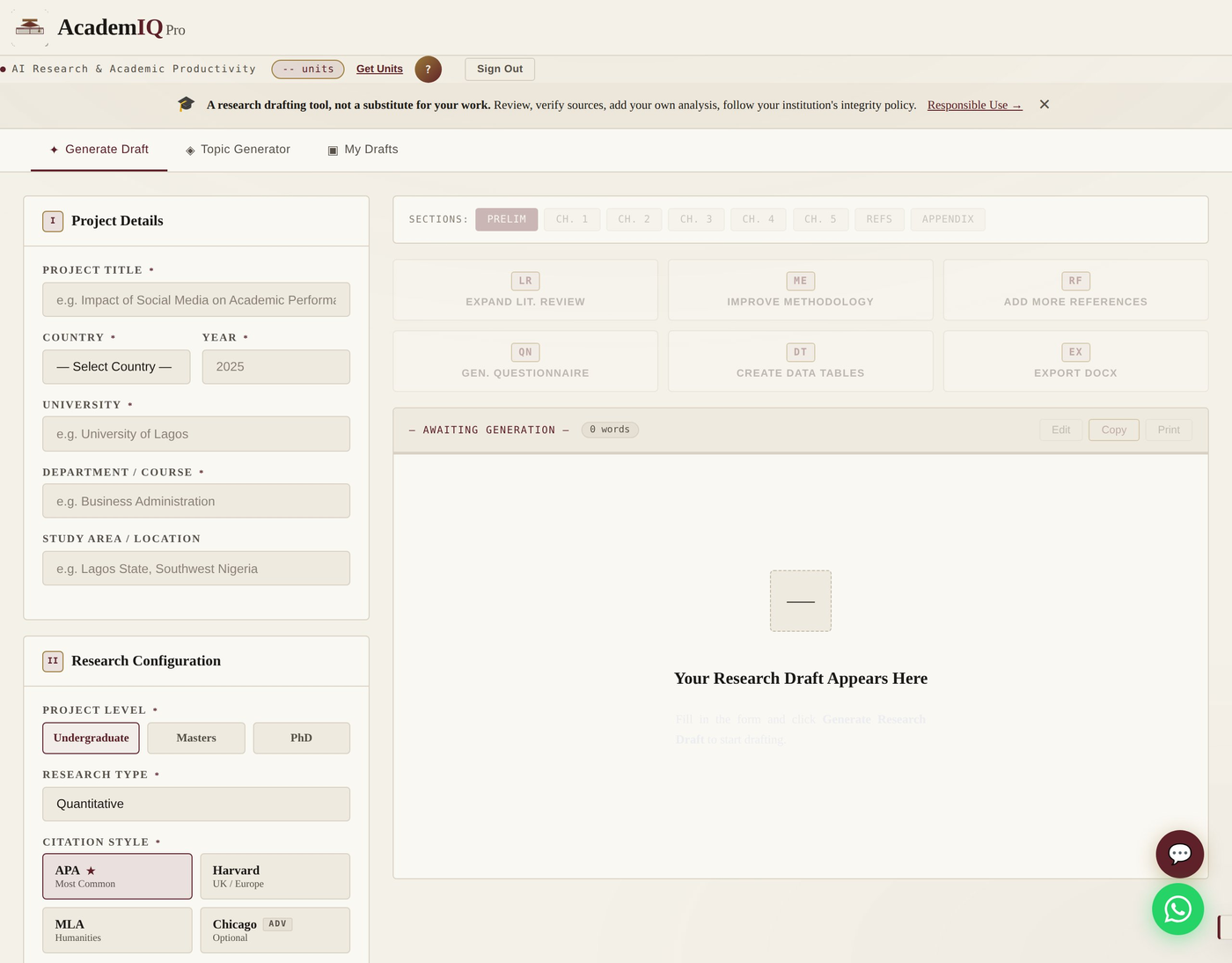
Students enter a topic, choose a department, and watch their full project generate section by section in a fixed order — preliminaries, Chapters 1 through 5, references, and appendix. The model auto-continues whenever it hits the token cap, so a complete project arrives without anyone watching for limits.

https://academiqpro.app
AcademIQ Pro — landing page hero
— Landing page / Public site
Business Model

Twenty units, four full projects.

Students pay ₦20,000 upfront for 20 units — enough to generate up to four complete research projects. Paystack handles checkout; Resend handles transactional email; a referral program pays ₦4,000 per successful referred payment, with WhatsApp as the primary support channel.

https://academiqpro.app
AcademIQ Pro — draft generation workspace
— Generate Draft workspace / Section controls
The Challenge

An AI product, shipped solo.

AcademIQ Pro is a real commercial product with paying users — built and maintained by a single operator. That meant we needed an architecture that didn't depend on a team to run: rapid command-line deploys, minimal dependencies, observable failure modes, and self-healing where possible.

The hard problem isn't generating one chapter. It's generating seven sequential sections reliably, recovering when the model hits a token cap, and ensuring no student is ever charged for a failed generation.

The Build

Reliability as the unit economics.

A single-file HTML/CSS/JS frontend calls the Anthropic API directly with section-by-section streaming. Each section knows what comes next; failed sections trigger an automatic unit refund via Supabase, with a localStorage fallback to catch any that slip past. Edge Functions handle webhook safety nets and privileged operations via the service role key.

The Android app started as a Capacitor WebView, then migrated to pure native Java when Paystack v2's popup couldn't open inside Capacitor's BridgeActivity. Same single-file frontend, different host. Vercel CLI for web deploys, Gradle wrapper for Android — the whole pipeline lives in the terminal.

  • Claude Sonnet 4, direct from client
    Section-by-section streaming with automatic continuation past token caps.
  • Auto-refund safety net
    Failed generations refund units via Supabase, with localStorage as a fallback.
  • Paystack + Resend
    Naira-native payments, transactional email, Edge Functions for privileged ops.
  • Native Java for Android
    Migrated off Capacitor to fix Paystack popup compatibility — same frontend, different host.